

HAIR LOSS GUIDE · THE MEN CLINICS
The Norwood Scale Explained
Seven stages, one shared language. Knowing yours tells you what is realistic and how much donor supply to keep in reserve.
Last clinically reviewed: August 2026
The Norwood scale classifies male pattern hair loss into seven stages. It is the shared language surgeons use to plan treatment.
Knowing your stage tells you roughly how many grafts you might need, whether surgery is appropriate yet, and how much donor supply you should keep in reserve for the future.
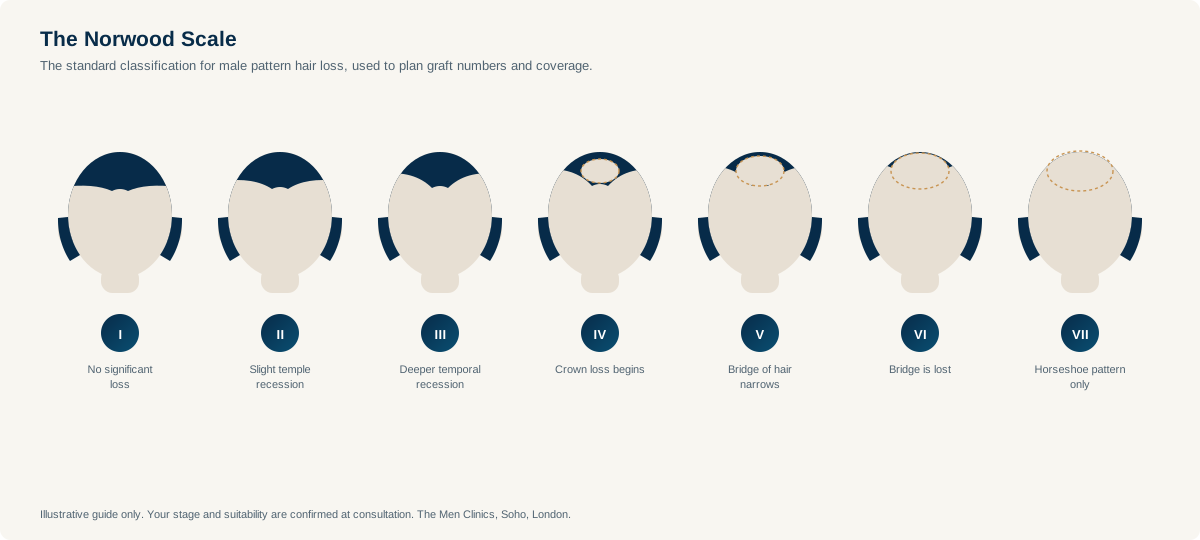
The stages explained
| Stage | What it looks like | Typical approach |
|---|---|---|
| I | No significant recession | Monitor; no treatment needed |
| II | Slight temple recession | Medical therapy; small procedure possible |
| III | Deeper temporal recession, the classic M | Medical therapy, often with surgery |
| III vertex | Temporal recession plus early crown thinning | Medical therapy first, then plan |
| IV | Larger frontal loss, defined crown patch | Front third prioritised |
| V | The bridge between front and crown narrows | Staged planning, donor management |
| VI | Bridge lost, front and crown merge | Prioritised coverage |
| VII | Horseshoe of hair at sides and back only | Limited donor; SMP often considered |
How your stage guides the plan
- It sets a realistic graft range before anything is measured
- It indicates whether loss is likely still progressing
- It flags when stabilising medically should come before surgery
- It tells your surgeon how much donor supply to hold back
- It provides a baseline to measure future change against
 Clinically reviewed by Dr. Ducu Botoaca
Aesthetic & Hair Transplant Surgeon and founder of The Men Clinics, Soho, London. This page is general information and is not a substitute for a personal medical assessment.
Clinically reviewed by Dr. Ducu Botoaca
Aesthetic & Hair Transplant Surgeon and founder of The Men Clinics, Soho, London. This page is general information and is not a substitute for a personal medical assessment.
Frequently asked questions
What Norwood stage am I?
Compare your hairline and crown against the diagram above. Most men fall between stages II and V. A clinical assessment refines it, because miniaturising hair that is still present but thinning is hard to judge in a mirror.
At what stage should I get a transplant?
There is no single stage. It depends more on whether your loss has stabilised and how much donor you have. Men at stage II or III with rapid recent progression are usually advised to stabilise medically for twelve months first.
Will I definitely progress to stage VII?
No. Most men stabilise somewhere between stages III and V. Family history on both sides gives some indication, though it is not a reliable predictor for any individual.
Is there a Norwood scale for women?
Female pattern loss follows a different distribution and uses the Ludwig scale instead, which describes diffuse thinning with a preserved frontal hairline.
KEEP READING
More hair loss guides
Ready to talk to a specialist?
Book a free, no-obligation consultation at our Soho clinic. You will get an examination, an honest assessment and a written plan with no deposit requested on the day.
The information on this page is general guidance and is not medical advice. It does not replace a personal consultation with a qualified clinician. Individual results vary. The Men Clinics, Soho, London.