

HAIR LOSS GUIDE · THE MEN CLINICS
FUE vs DHI: Which Is Right for You?
Same extraction, different placement. Here is what actually separates them, and why the choice matters less than who is holding the instrument.
Last clinically reviewed: August 2026
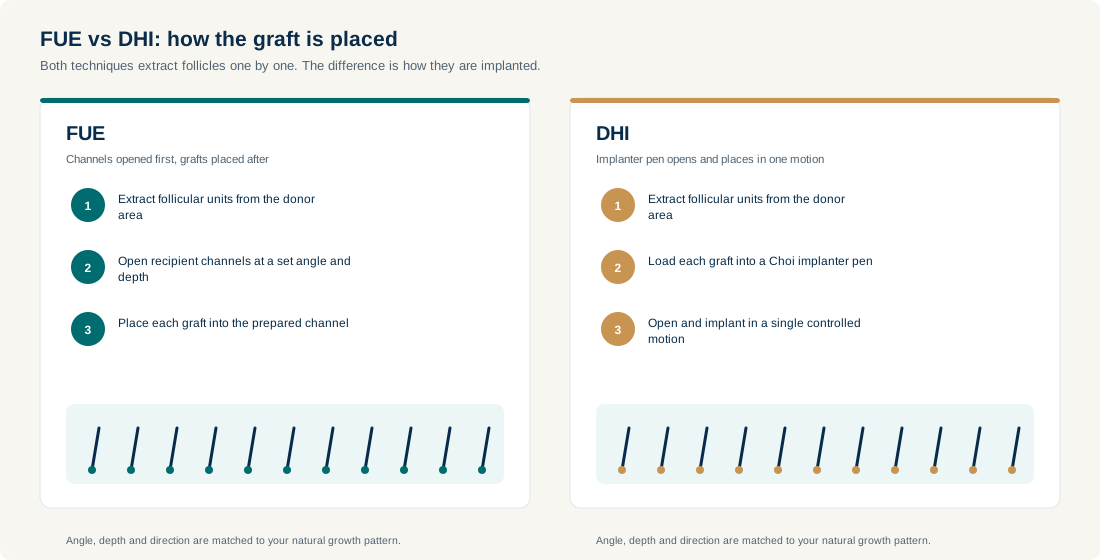
FUE and DHI use the same extraction method. The difference is entirely in how the graft is put back.
This is the most misunderstood comparison in hair restoration, partly because clinics market DHI as a completely separate procedure. It is not. Both are follicular unit extraction. What changes is implantation.
Head-to-head comparison
| FUE | DHI | |
|---|---|---|
| Extraction | Individual punch | Individual punch (identical) |
| Implantation | Channels first, then placement | Implanter pen does both at once |
| Angle control | Very good | Excellent |
| Speed per graft | Faster | Slower |
| Large sessions | More practical | Longer, needs bigger team |
| No-shave option | Limited | Often possible |
| Graft handling | Forceps placement | Minimal handling |
| Typical cost | Standard | Usually higher |
How to choose
The honest answer is that your surgeon should choose, after examining your scalp. But the decision usually turns on three questions.
- How many grafts do you need?Above roughly 3,000, FUE is often more practical. Below 2,000, DHI's advantages have more room to show.
- Do you still have significant native hair?If you are infilling between existing hairs, DHI's precision reduces the risk of damaging them.
- Can you take visible downtime?If not, DHI's no-shave feasibility may be decisive.
 Clinically reviewed by Dr. Ducu Botoaca
Aesthetic & Hair Transplant Surgeon and founder of The Men Clinics, Soho, London. This page is general information and is not a substitute for a personal medical assessment.
Clinically reviewed by Dr. Ducu Botoaca
Aesthetic & Hair Transplant Surgeon and founder of The Men Clinics, Soho, London. This page is general information and is not a substitute for a personal medical assessment.
Frequently asked questions
Which technique gives better results?
Neither, inherently. Both place your own follicles. Outcome is driven by design, angle, density planning and operator skill. A skilled surgeon using FUE will beat an inexperienced team using DHI.
Is DHI worth the extra cost?
It can be, for hairline work, infill between existing hairs, or where you need to avoid shaving. For a large session rebuilding the whole frontal third and crown, the premium often buys you less than you would think.
Can both be used in the same procedure?
Yes, and it is common. DHI for the hairline where angle precision matters most, FUE for bulk density behind it. This hybrid approach is often the most sensible use of both.
Does DHI cause less shock loss?
Potentially, because grafts are placed between existing hairs with less tissue disruption. This is one of its clearer practical advantages for men who are thinning rather than bald.
Is recovery different?
Broadly the same. DHI patients sometimes report slightly less crusting in the recipient area. Both follow the same growth timeline: shedding at two to six weeks, growth from month four, final result at twelve to eighteen months.
KEEP READING
More hair loss guides
Ready to talk to a specialist?
Book a free, no-obligation consultation at our Soho clinic. You will get an examination, an honest assessment and a written plan with no deposit requested on the day.
The information on this page is general guidance and is not medical advice. It does not replace a personal consultation with a qualified clinician. Individual results vary. The Men Clinics, Soho, London.